Drop the documents.
Deliver the deal.
Bank statements and credit reports go in. A branded, client-ready Funding Analysis comes out, underwritten against 9,934 lenders. Every figure computed from the file. Nothing guessed.
Your first client file is free on every workspace.
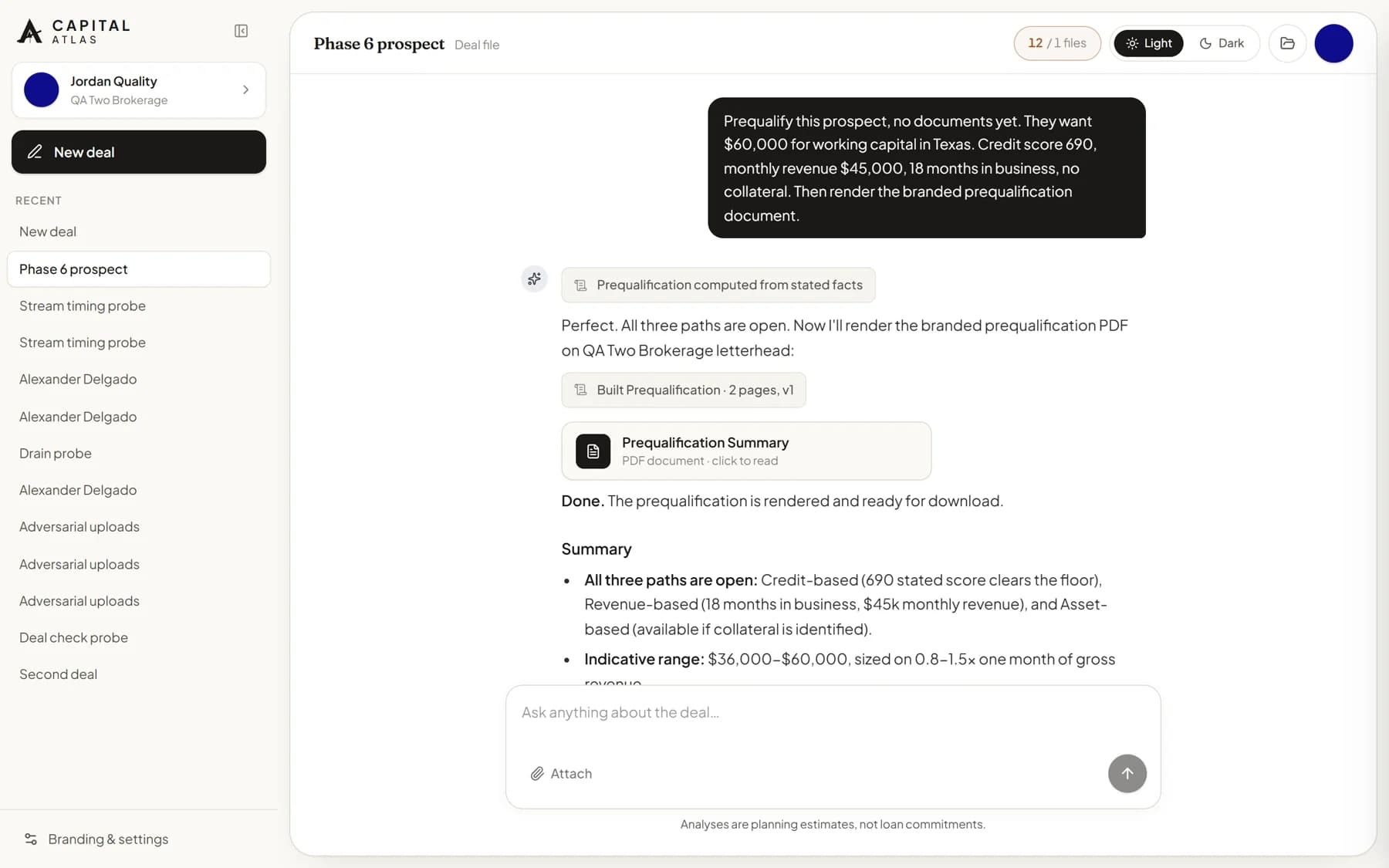
9,934
Lenders in the network
37,720
Products with live criteria
3
Paths of lending, every deal
6
Documents on your letterhead
Reads. Matches.
Writes the document.
Three jobs a broker does by hand today, done from one thread and handed back as a document a lender expects to see.
Reads the file, to the cent
Bank statements transcribed line by line. Credit reports per bureau. Scanned deeds, leases and operating agreements read too.
Matches real lenders
Hard gates evaluated in code against the extracted profile. Unknown never counts as a pass, and no lender is ever invented.
1. How much is the client asking for?
2. What is the money for?
a. Working capital b. Business credit cards c. Equipment d. Real estate e. Something else
Asks only what matters
Amount and use of funds, as numbered choices. Everything else goes into the document as a flagged assumption.
The document a lender expects to see.
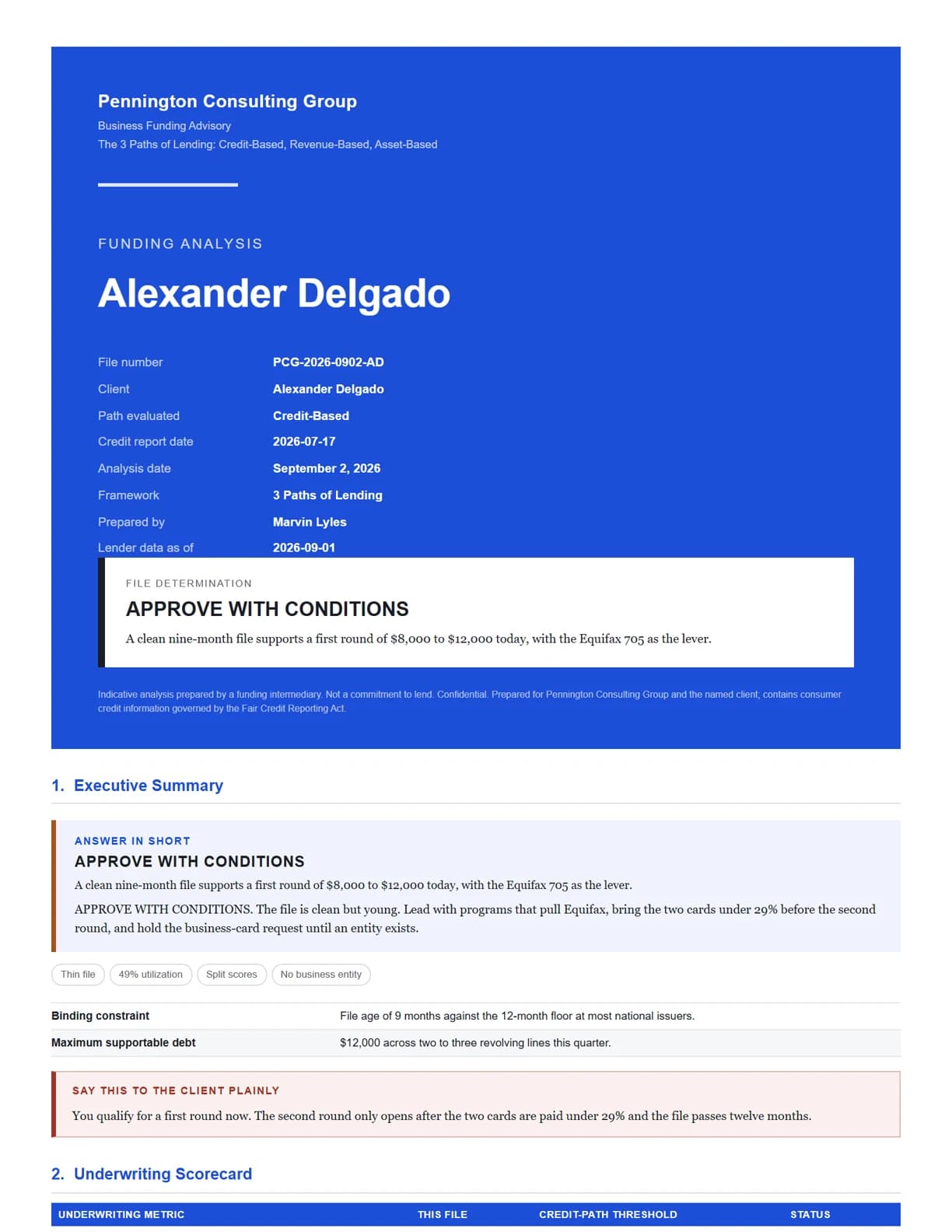
Cover, answer in short, underwriting scorecard, credit snapshot, accounts above target, structures compared, what must still be resolved. On your letterhead, with your file number.
- Verdict in one word and the sentence that governs
- Ten metrics marked PASS, MARGINAL, or FAIL
- The plain-language line you read to the client
- Open items ranked CRITICAL, HIGH, MEDIUM
- Revision number and what it supersedes
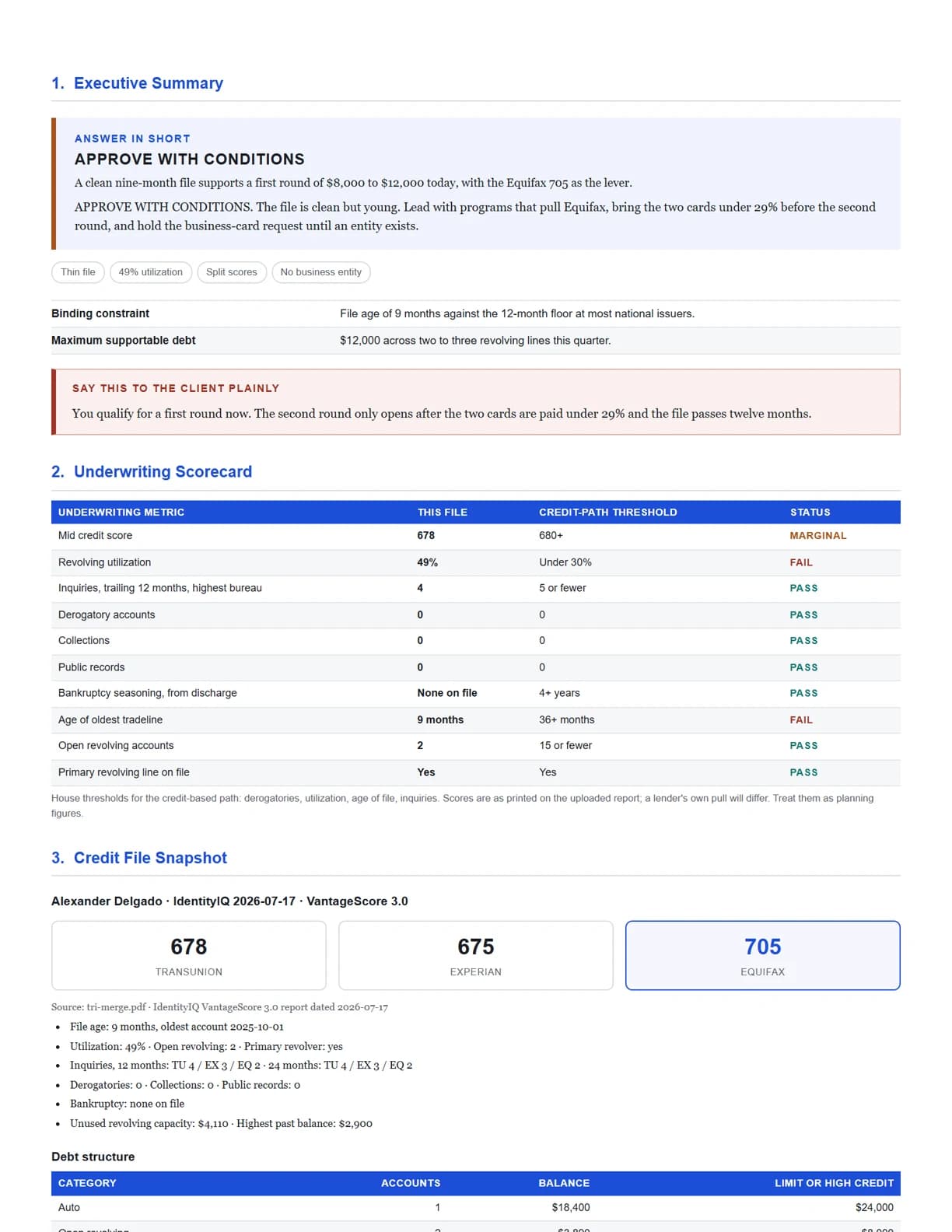
Funding Analysis
InternalThe full read: verdict, binding constraint, scorecard, three paths, structures, open items.
Prequalification
Client-facingThe three paths from stated facts alone, before any document exists. Free on every plan.
Pre-Approval Letter
Client-facingCredit, revenue and equipment files. Conditions numbered, fee block computed.
Letter of Intent
Client-facingReal estate files. Project table, capital stack, conditions precedent, signature blocks.
Lender Report
InternalRanked shortlist from the database only, with tier, verification status and data gaps.
Document Checklist
Client-facingWhat the pursued products require, prioritized, marked against what is on file.
One thread from upload to signed document.
No prompt writing. The broker describes the deal once, uploads what they have, and reviews what comes back.
- 1
Drop the documents
Bank statements, credit reports, deeds, leases, quotes, GC bids. Scans are read too.
- 2
Answer once
Amount and use of funds, asked as numbered choices. Nothing else is required to proceed.
- 3
Underwrite
Every metric computed server-side, the three paths evaluated, lenders matched in code.
- 4
Deliver
The branded PDF lands in the thread. Correct a figure and every dependent number cascades into a new revision.
Every category your client could need.
Whether the client needs five thousand or five million, funding comes from one of three places. Every deal is read against all three.
Credit-Based
- Business credit cards
- 0% intro card stacks
- Unsecured lines of credit
- Term loans
- Personal-guarantee lines
Revenue-Based
- Merchant cash advance
- Revenue-based financing
- Invoice factoring
- Working capital advances
- Net 30/60/90 terms
Asset-Based
- Bridge loans
- Hard money
- Commercial real estate
- Equipment financing
- Land and construction
The rules are enforced by the server, not by the prompt.
Built for a regulated business. Every safeguard below is code, not a request to the model.
Tenant isolation
No firm ever sees another firm's deals, uploads or documents.
Lender data gated
Records leave only as a scenario-matched shortlist: row-capped, quota-limited, logged.
Non-commitment by design
Every client document carries the intermediary notice. A letter never reads as a lender approval.
Contacts stay internal
Rep names, relationship notes and internal ratings never reach a client-facing page.
Priced per deal, not per surprise.
A file is one client. Every document on it is included. Overage is billed, never blocked.
Deal Check
Qualify a deal on a phone call.
$99
per month
50 deal checks a month
50 deal checks a month, six fields, no documents
See planSolo
One broker, unlimited clients.
$299
per month
30 files a month
30 client files a month, unlimited documents off each
See planDesk
Most popularFor active brokerages.
$279
per seat, monthly
30 files per seat a month
Everything in Solo, per seat
See planWhite-label
Quoted. Annual commitment.
$2,500
per month, from
Annual commitment
Own domain, own product name, no Capital Atlas branding
Request a quoteQuestions brokers ask.
Still unsure? Open the workspace and run a deal. The first one shows you more than any answer here.
Where does the lender data come from?
The Capital Atlas network: 9,934 lenders and 37,720 products, maintained as the source of truth. Analyses never invent a lender, a rate, or a term. If a figure cannot be reconciled to the underlying data, it is flagged rather than estimated.
Are the deliverables branded with my firm?
Yes. You set your company name, logo, colors, advisor details, and fee defaults once. Every Funding Analysis, Letter of Intent, Lender Report, and Document Checklist renders on your letterhead. Clients see your brand, not ours.
What documents can I upload?
Bank statements, credit reports, tax returns, and financial statements as PDF, JPG, PNG, or CSV. Statements are parsed transaction by transaction so gross deposits, adjusted revenue, and a conservative basis are computed rather than approximated.
How does an analysis count against my plan?
A deal counts once when it produces a deliverable. Follow-up questions, corrections, and revisions inside the same thread are free. Uploading heavy documents does not bill you twice.
Can other firms see my deals or my clients?
No. Tenant isolation is absolute. Deals, uploads, client documents, and generated deliverables are scoped to your firm and are never visible to another account.
Do my clients ever see lender contacts?
No. Rep names, direct contacts, relationship notes, and internal ratings are internal-only and are stripped before anything reaches a client-facing document. The Lender Report is an internal deliverable.
What happens if I cancel?
Deliverables you have already generated remain yours to download. There is no lock-in on documents your clients have already received.
How is this different from asking a general AI chatbot?
A general chatbot guesses lender criteria from training data. Capital Atlas underwrites against a live lender database, computes every figure from your actual documents, and produces the branded deliverable your client signs.
What do lenders actually look at for credit-based funding?
Four things, and the score alone is not what sets the amount: derogatories (lates, collections, charge-offs, liens, judgments, bankruptcies), utilization (keep it under 30%), age of the credit file, and inquiries. Banks lend to borrowers who do not look like they need the money, so a file loaded with recent inquiries reads as desperate.
Can a start-up with no revenue get funded?
Yes, on two of the three paths. Credit-based funding requires no income documents and no collateral, so start-ups qualify on credit profile alone. Asset-based funding works whenever there is collateral to pledge, whatever the credit looks like. Revenue-based funding is the one that needs trading history, typically three months minimum.
How fast does funding actually close?
Credit-based deals typically close in 5 to 10 business days. Revenue-based and asset-based run 3 to 15 business days depending on documentation and, for asset deals, the appraisal. The analysis itself comes back in minutes, so the timeline is the lender's, not yours.
Your Capital Atlas is waiting.
Drop a deal in and read the full underwriting file, every figure traced back to the document it came from.